Wuh-Zhei doesn’t rise. It stacks.
Every Plate in Wuh-Zhei is divided into the same eight Districts. Not for tradition. For bureaucracy. Standardized names mean smoother logistics, cleaner reports, and the illusion that all is well. The names stay the same. What they actually are does not.
Each District changes dramatically depending on the Plate. Some are proud pillars. Others are buried or broken. Some are only Districts by name, ruins, contested zones, single buildings clinging to a legacy shape or sometimes fully Unraveled.
The layout is constant.
Azure District
Conceptual Role: Commerce. Bureaucracy. Transit. Markets. Governance.
Azure is the city’s bloodstream.
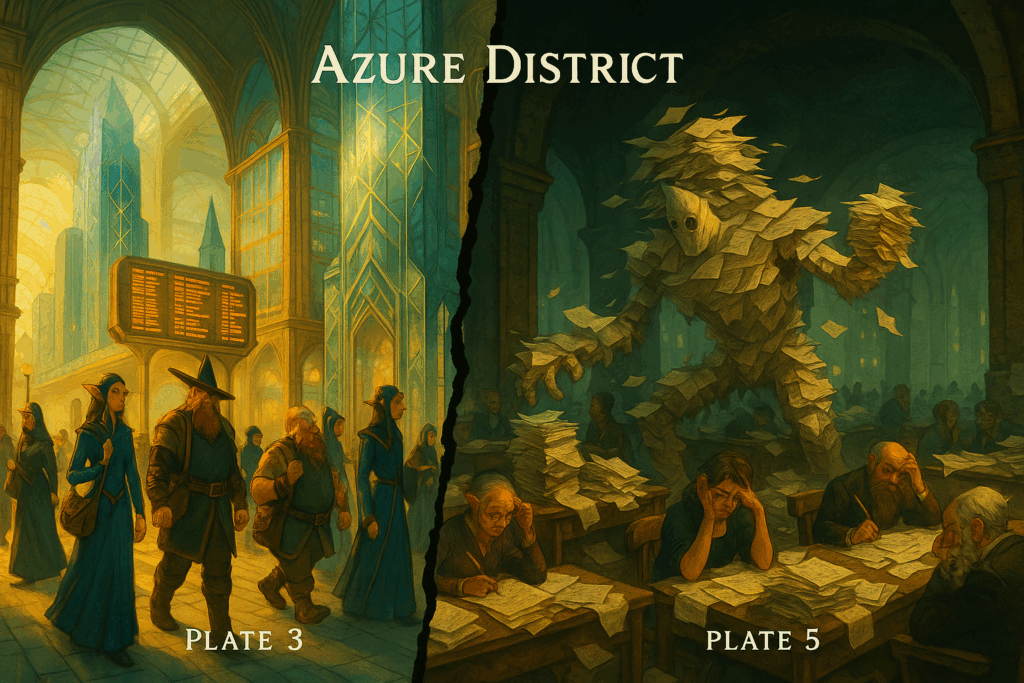
Everything moves through here. Cargo. Paperwork. People. Permission. If it’s been traded, taxed, filed, or falsified, it passed through Azure. Supply chains coil through its depots. Railspells crackle across its terminals. Markets scream, judges sentence, and somewhere in the back, a courier’s screaming because Plate Five’s customs grid just went down again.
Azure is transit between plates. The bottleneck. The artery. The border. It’s what keeps the city linked, barely. On Plate Two and Three, Azure is pristine. Enchanted signage. Predictable queues. Smooth civil infrastructure with just enough surveillance to be polite. On Plate Five, it’s an exhausted grind of rerouted manifests, smudged spell permits, and black-market passes handed off between Paragon patrols.
Trade doesn’t stop. Transit doesn’t wait. Azure keeps going because it has to.
Amethyst District
Conceptual Role: Research. Academia. Magical and Scientific Invention. Strategic Development.
Amethyst is Wuh-Zhei’s calculated future.
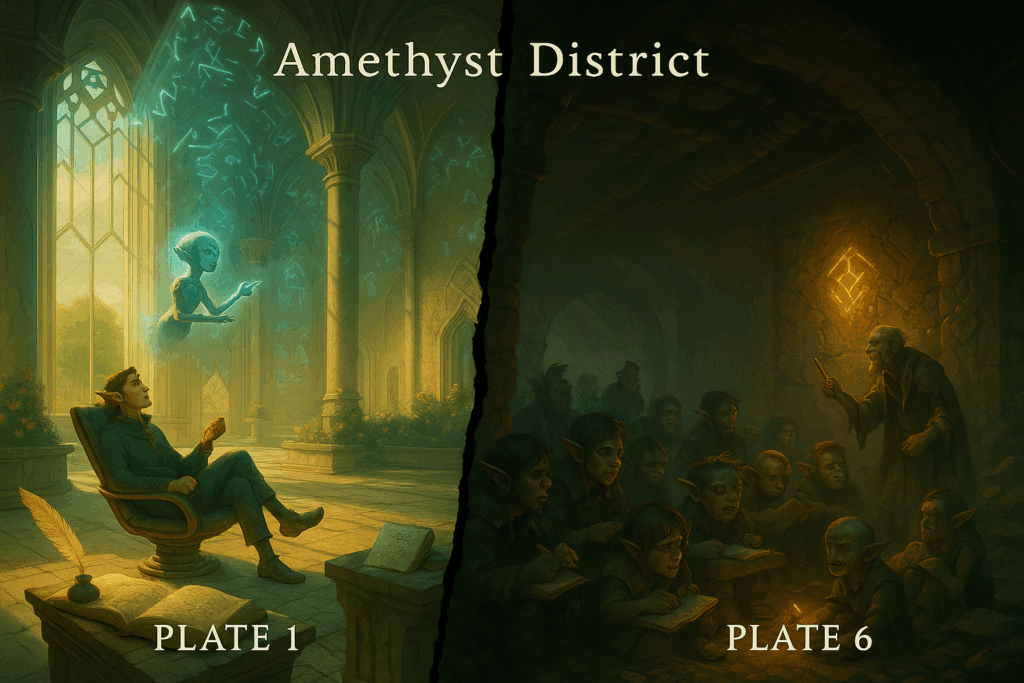
The Unraveling is here, and Amethyst is where wizards try to outthink apocalypse. Some say the city and its other districts only exist to keep the Amethyst halls lit, their school’s attended and their wizards fed. An endless churn of grants, failures, and breakthroughs. Ancient minds pushing one last prototype. New blood learning to do and be better.
Here, labs and lecture halls tangle with time itself. Arcane universities rival divine upstarts. Research domes trace the seams of reality. On Plate Three, Amethyst buzzes: Optimist-funded planar experiments, Paragon spellweapon prototypes, Chronomancer’s attempting to crack dual concentration. Plate Five? That’s Transneuroclast territory now, and if you’re not careful, you might be the next unwilling subject to crack their Great Puzzle.
Every miracle has a blueprint. Every blueprint starts here.
Ruby District
Conceptual Role: Metallurgy. Weaponry. Infrastructure. Sanitation. Barracks.
Ruby burns.
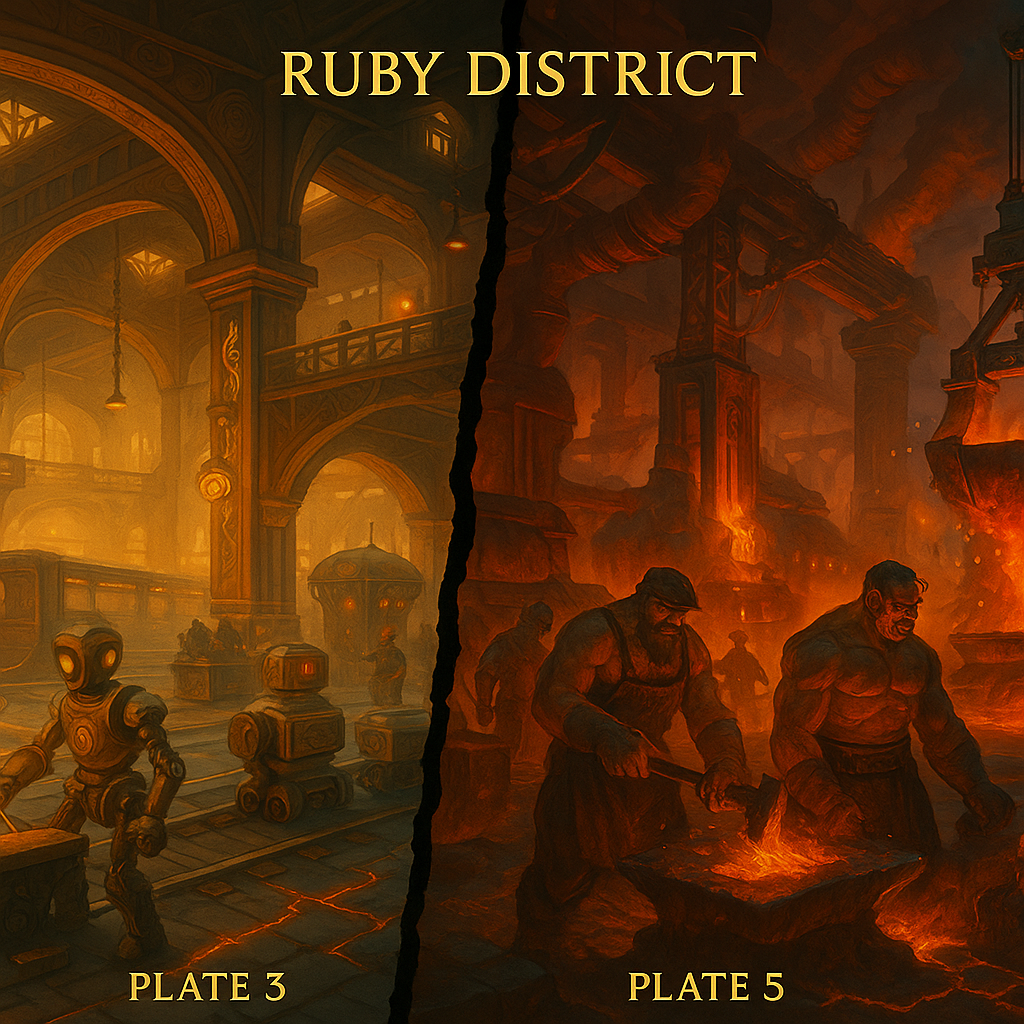
It is heat and metal and the sound of hammers that don’t stop. This is where Wuh-Zhei builds its bones: the armored undercarriage of every lift, the plated housing of every patrol construct, the sharpened edge of its deterrents. Smelters scream. Arcforges pulse. Metal flows like blood.
Ruby is raw production. Weapons are built here. Golems are assembled here. Infrastructure is imagined in Amethyst, but it’s made real in Ruby, one searing weld at a time. On Plate Five, Ruby runs on volatile magic and labor nobody tracks. Open-air assembly lines and overlapping toolchant harmonics, golems mid-limbs, and foremen who don’t sleep. Plate Three is precision-crafted: high-temperature spellsteel lathes, containment chambers for volatile innovations, armor fitters working off blueprints that are themselves warded.
It’s loud. It’s hot. It’s dangerous. And it’s absolutely necessary.
Citrine District
Conceptual Role: Fabrication. Visual Design. Consumer Goods. Mass Production.
Citrine is where Wuh-Zhei makes the things people touch.
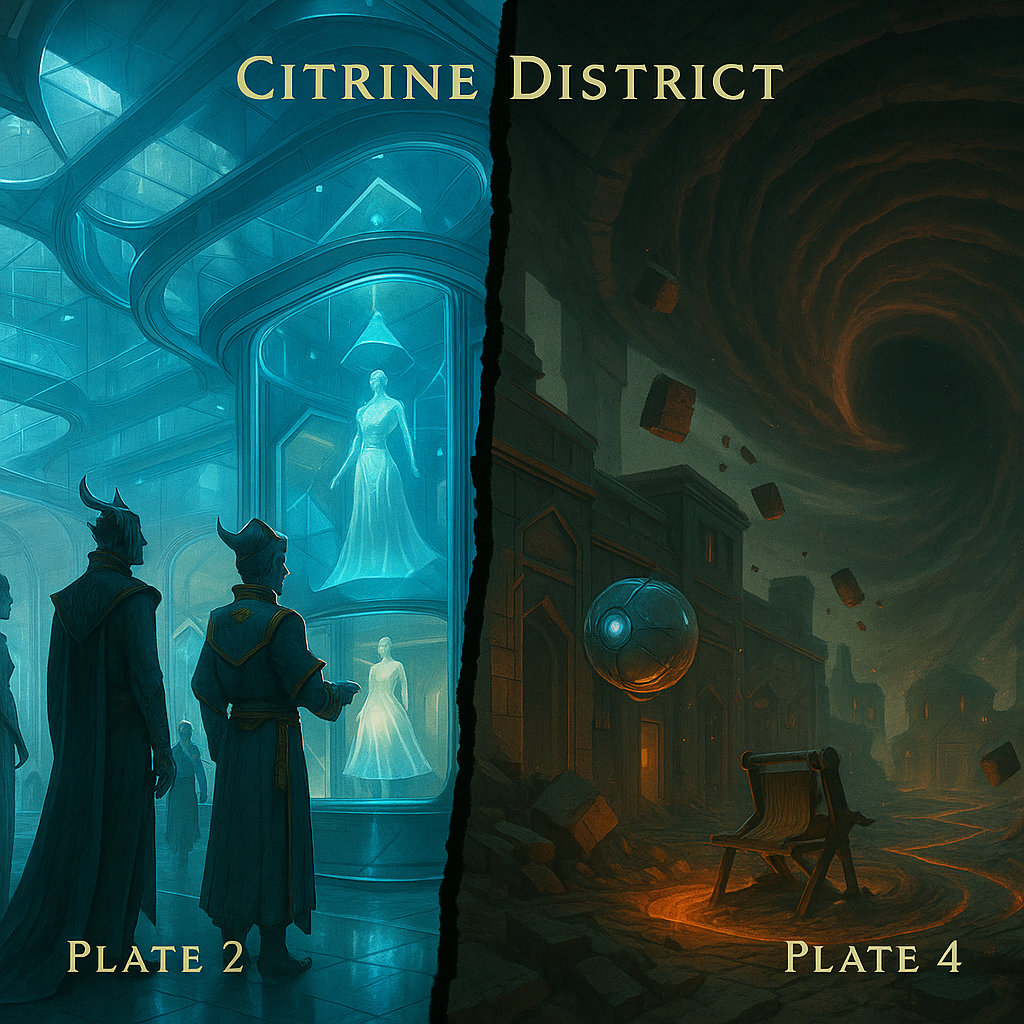
Clothing. Tableware. Buckets. Blankets. Party masks. Posters. Lunchboxes. Festival flags. Mass-printed scrolls. Everything you use and don’t think about. If it’s shaped by mold, woven by thread, or pressed with a logo, it probably came from Plate Five or Six Citrine.
It’s not magical. It’s not forged. It’s not grown.
It’s everything else. Fast, cheap, essential.
Meanwhile, Plate Three’s Citrine is glamor on an assembly line: uniforms, printed signage, paper props, party masks, coded tokens, and pre-fabricated civic paraphernalia. If it’s flashy, decorative, and breaks after three uses, it’s from Citrine.
Plate Five’s Citrine is full-throttle production: song-powered looms, wax-sealed crates, soot-smudged canneries still running two decades after they should’ve broken. Plate Four’s? Almost fully swallowed by the Unraveling but still technically active. Kind of. Plate Two’s? Elegant fabrication houses with custom tailoring and drinkware that comes with an apology note.
Citrine makes the mundane miraculous either through volume or design.
Rhodonite District
Conceptual Role: Entertainment. Performance. Religion. Community Life. Memory and Museums.
A city stacked as high and dense as Wuh-Zhei is bound to get too hot. There’s a kind of pressure valve Ruby can’t forge and Citrine can’t conjure. Rhodonite is that valve. The place to let off steam. The place people go to find release.
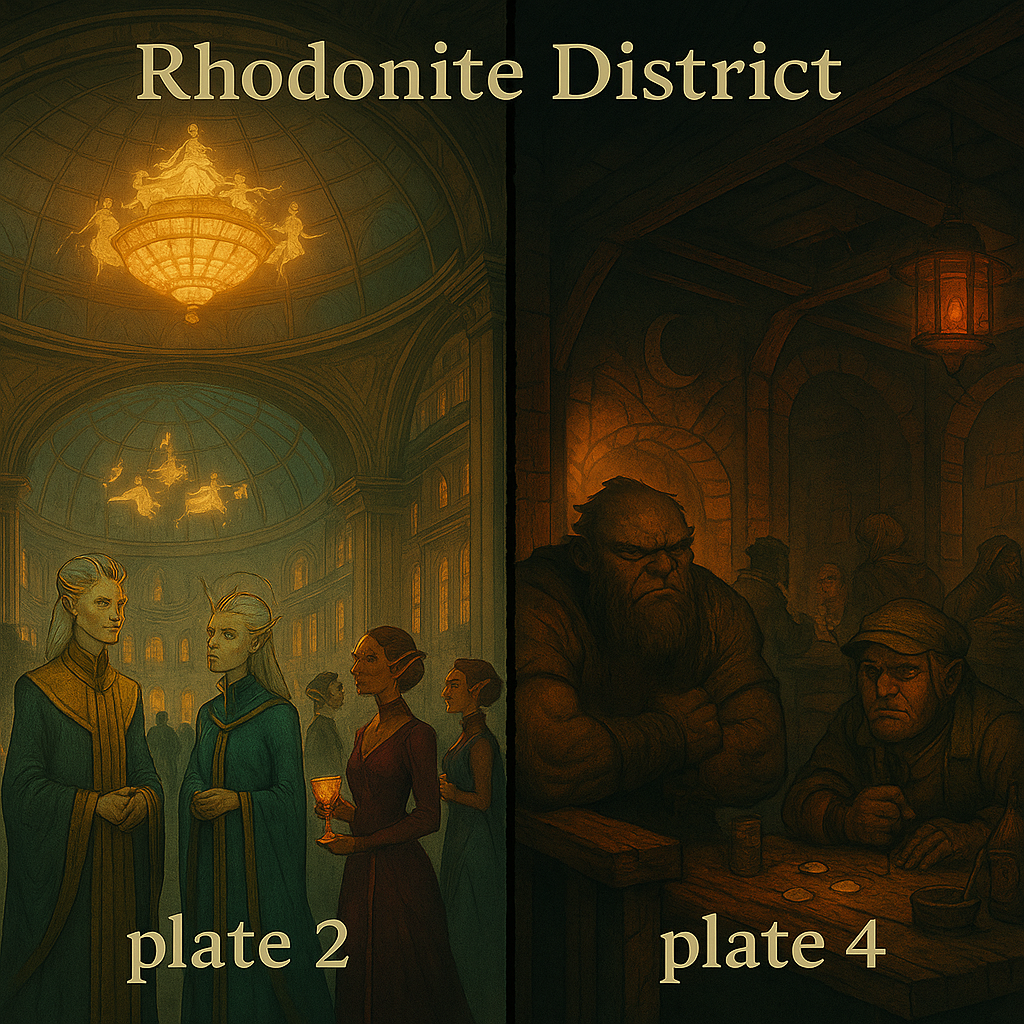
It’s the celebration. The eulogy. The distraction. The question no one asked and the answer shouted anyway. Theaters. Temples. Taverns. Fight pits. Choir towers. Lecture halls. Anywhere people go to express themselves or forget themselves. It’s civic identity with a spotlight.
Plate Five’s Rhodonite hums like a bassline: jazz clubs, conjured light shows, movement magic, rhyme-duels, and spell-synced dance floors. Plate Four’s is infamous for Boss Sin’s casinos. Plate Three’s is more refined: the hub of drama, funded experimental plays, and seasonal civic rituals. Plate Two’s? Operatic austerity. You don’t attend, you’re seen.
And maybe, on some nights, there’s a kind of magic in Rhodonite that can’t be found in a spellbook. Because between warring factions and a world that’s literally unraveling, there might still be room for art.
Amber District
Conceptual Role: Repair. Recovery. Maintenance. Sanitation. Enhancement.
Amber is where broken things get better.
Cracked tiles. Glitched charms. Sprained ankles. Misfiring golems. Faulty organs. It’s all Amber.
This is the city’s patch kit and its test bench. The district handles what no one else wants to keep handling, sick bodies, dying runes, failing plumbing, sagging enchantments. Stitch it. Tune it. Realign it. If it can’t be salvaged, Amber knows how to say goodbye. But more often than not? It can be made better.
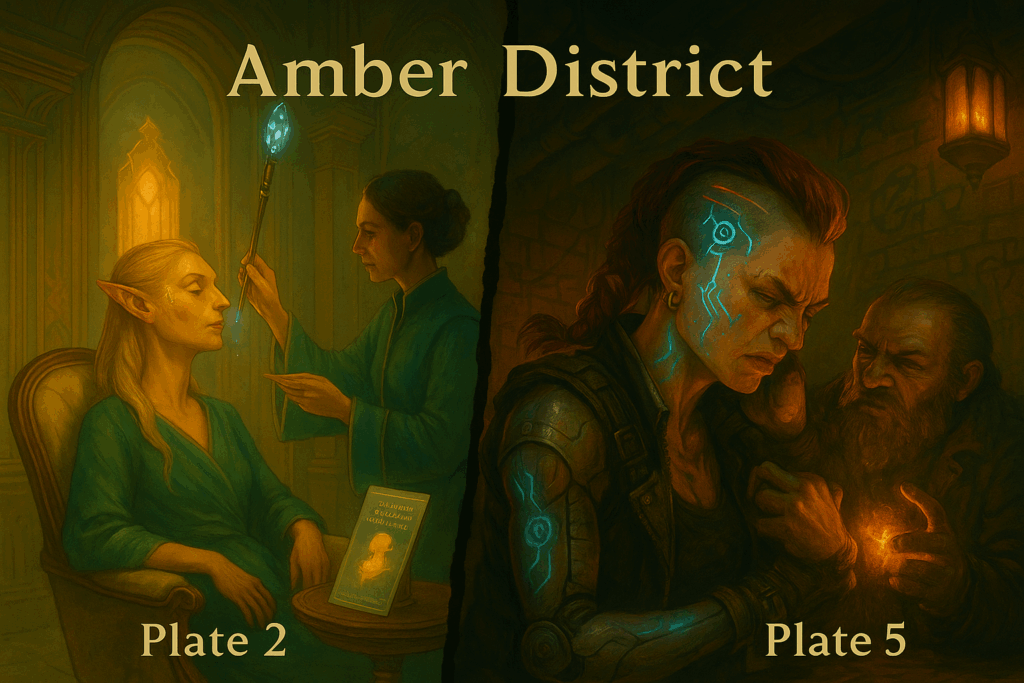
Hospitals are here. So are hospices, repair co-ops, laundromancers, boiler clerics, rune-engravers, and low-tier enchantment labs. In Amber, limbs are healed or replaced. Brains are soothed or rewired. On the right plate, with the right signature, you might leave with more than you came in with.
Sanitation lives here too. Waste processing. Street sweeping. The unclaimed dead. You might walk by a corpse-sled and a charm tuning booth on the same block. That’s just Amber. It doesn’t flinch. It works.
On Plate Three, Amber is structured: numbered queues, civic grant-funded menders, regulated upgrade access. On Plate Five, it’s scavenged miracles, Transneuroclast enhancements done under flickering light, rune-patches held in place by spit and willpower. On Plate Two? Amber is elective. Cosmetic. Voluntary upgrades and restorative treatments refined to elegance.
Other districts build new things.
Amber takes what’s broken, and makes it work. Sometimes better than before.
Other districts make things.
Amber makes things last.
Jade District
Conceptual Role: Agriculture. Nourishment. Green space. Quiet continuity.
Jade is where people go to breathe. Or plant. Or hope for a little more space.
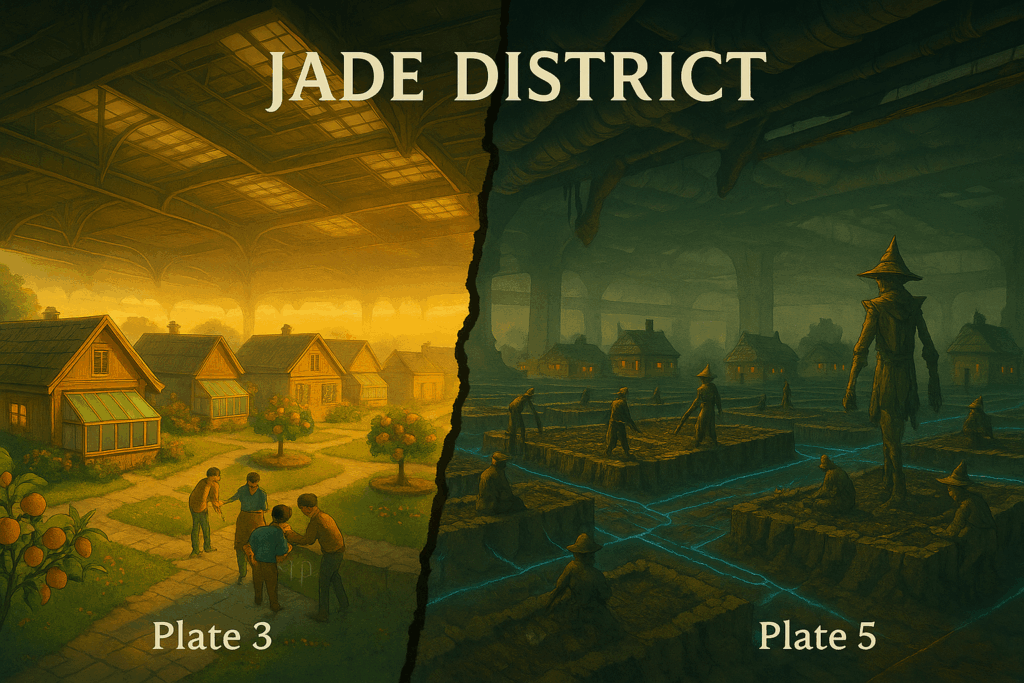
It feeds the city, not just with food, but with breath. With rhythm. With something like patience. On Plate Five, Jade is narrow field strips and conjured soil cults, harvest wagons creaking past overgrown canals. On plate Three it’s suburban housing nestled between vineyards and peach orchards. Expansive weather-controlled gardens behind creaking wood gates.
This is where arcane agriculture blends with hard work and sweat, where hybrids of conjuration and compost keep calories flowing to the plates above. Schools teach math via crop cycles, literacy via herbal labels. Clinics smell like mint and smoke. Local shops trade spell-treated carrots and emotion-resistant onions. On Plate Two, Jade feels like it remembers something. On Plate Five, it’s just spread out enough that people feel like they might actually own the property they sharecrop on.
Jade is what sustains us.
Obsidian District
Conceptual Role: Secrets. Structural Integrity. Emergency Containment. Custody and Disposal.
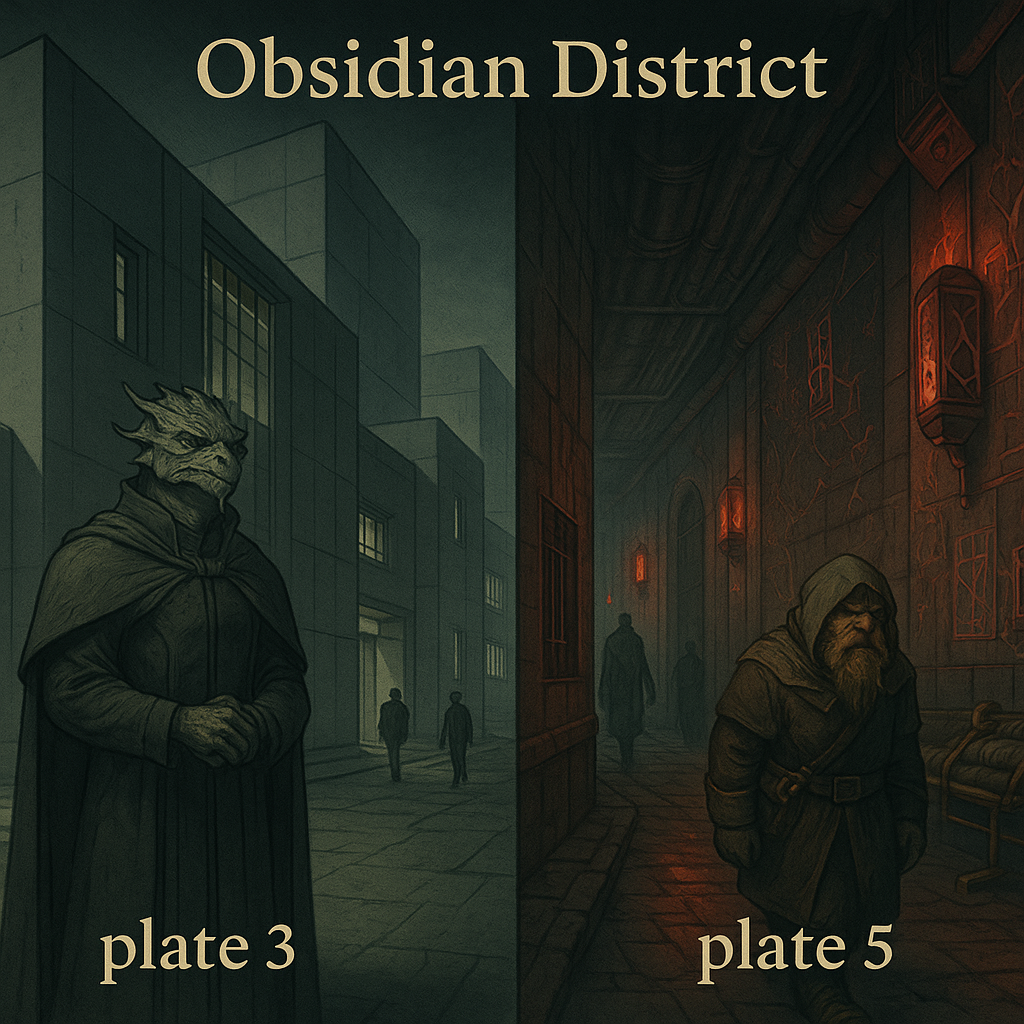
Obsidian is Wuh-Zhei’s contingency plan. Small. Isolated. The smallest district on each plate.
It is where the city locks up what it can’t solve. Hazardous projects and hazardous people. Abandoned constructs. If something explodes in Obsidian or somebody riots in Obsidian, the rest of the city will survive.
On Plate Three, it’s ultra-regulated magical storage. An upscale prison. Black-badge researchers on a leash. On Plate Five, it’s a prison industrial district meat pipeline for the Transneuroclasts to siphon bodies. And Plate One? There are rumors that what’s locked away in their Obsidian is a type of magic best forgotten. The spell that killed the gods. But that’s just complete heresy.
When Wuh-Zhei runs out of time or options, it sends the problem to Obsidian.
And it does not ask for updates.